Saturday, July 24, 2021

Octodad: Imposter Syndrome in Suburbia

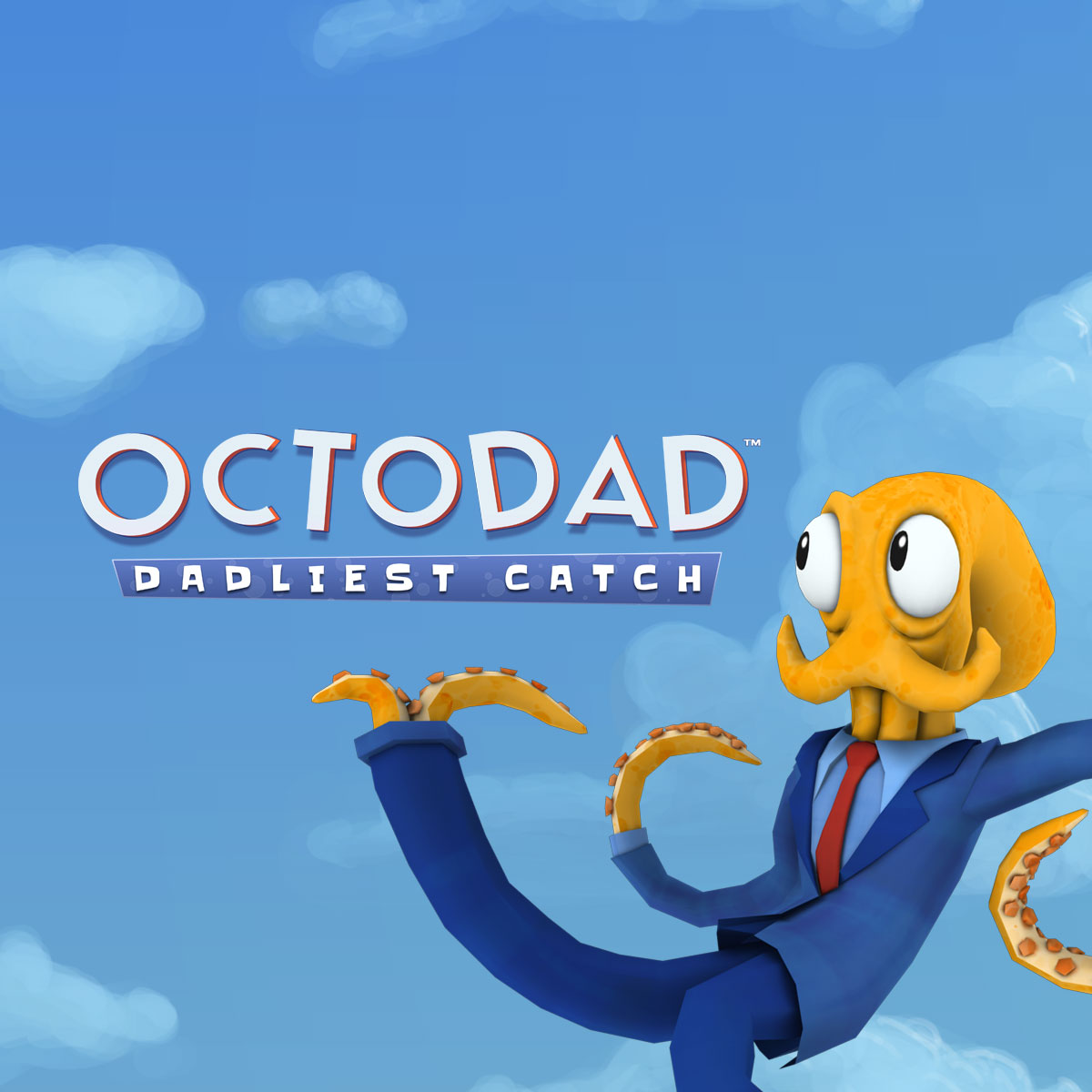
 Octodad - Loving Father. Caring Husband. Secret Octopus.

 No one suspects a thing.

I have a weakness for Developer Young Horses now, having played both Bugsnax and Octodad in the same summer.

As is often the case in humorous media, a simple premise (like an octopus occupying the role of a husband and father) doubles as a social commentary. I walked away from Octodad thinking about how we are all imposters in our own bodies, struggling to enact social and familial roles.

Octodad doesn't propose a solution for this struggle, but wow, it sure does showcase the struggle. The titular Octodad flails and slips through the grocery store. He tips over every furniture item in the living room. He shatters glass and stomps on flowers. His ineptitude exists at the very core of this game, with an intentionally obtuse control scheme and a wacky physics engine. Playing as Octodad is just as frustrating as it is delightful.

While Octodad's ineptitude is played for laughs, there are also moments of solemnity. He communicates through burbles, gestures, and expressions, transitioning from inconsolable panic to fatherly tenderness. Perhaps the most touching of his many moods is yearning. His wide, haunted eyes express more than dialogue ever could. Through glances both long and fleeting, we realize just how much Octodad treasures his fragile role.

Given the complexity of social desires and insecurities in Bugsnax, I have a hard time believing that Young Horses did not consider similar complexities when making Octodad. Octodad is trying to "pass" as human, and pass he does-- often with flying colors. In some sequences, his humanity manifests through clothing. Octodad successfully fills the role of "man" by wearing a suit and tie. Without these gendered signifiers, however, people see him as an octopus. While Octodad aspires for idyllic human cisgender heteronormativity, he exists outside of that system, so he must contend with the looming anxiety of  being discovered or outed. I wouldn't go so far to say that Octodad explicitly critiques gender roles, nuclear family units, or conformism, but I do think it successfully portrays imposter syndrome. How do we assert our belonging within a system that was not expressly constructed for us?

This question felt most pertinent in an explanatory flashback. During this flashback, we see Octodad dredge himself out of the water and onto a fishing boat. He slips behind crates to avoid being seen. In the ensuing stealth sequence, a shipmate swabbing the deck announces: "I hate octopuses." This small, offhand comment heightens Octodad's struggle. Despite unwarranted hate, Octodad carries forward with loving determination. "Love triumphs over all" is perhaps a simple and derivative conclusion for such a rich conundrum, but in the end, it is a genuinely heartwarming one.

Monday, July 5, 2021

Sky: Children of the Light

above and beyond its predecessor (literally)

Sky: Children of the Light for Nintendo Switch - Nintendo Game Details

In the summer of 2017, I visited my brother in Montana. I remember frequenting farmer's markets, hiking, and drinking huckleberry beer as ominous fires crept down the mountainside. One smoky night, I played Journey on the PS3. I skated down sand dunes alongside another cloaked figure whose scarf billowed in a wondrous swirl. Somewhere along the way, I lost track of my companion and continued on in solitude.

Journey is poignant but understated. It chooses its moments of reverie sparingly, from a rapturous sunlit corridor to an expanse of rolling hills. There is something barren about this game despite its splendor. It fills me with dutiful loneliness.

I was initially skeptical that Journey's spiritual successor, Sky: Children of the Light, could recapture that atmosphere. It retains some elements from its predecessor. Namely, skating through glimmering stretches of sand. It also retains a level of anonymity. Other players appear as ghosts -- just colorless contours. When you proffer a candle towards these ghosts, however, they gush with detail. Suddenly, you can see the color of their cloak, the style of their hair. These cosmetics differentiate experienced players from novices, much like the iconic scarf in Journey.

There are more players too. Sky: Children of the Light is an MMO, albeit an unconventional one. Players gather in central hubs, sit on benches, emote, and perform music. There are candles arranged in semi-circles and paper boats drifting in ponds, each inscribed with a heartfelt note. I have seen Chinese, Japanese, French, Russian (?), and English messages-- a testament to this game's global appeal. I have also chatted with other players briefly, exchanging warm greetings and names, though I will admit these exchanges shatter the wordless poignancy of Sky. The tenderest moments here are nonverbal. A proffered candle, an outstretched hand, a gleeful honk.

The main difference between Journey and Sky is flight. Flying is breathtaking. Plunging through plump, fluffy clouds, wings outstretched, contrails dragging from fingertips, it's hard not to feel a sense of wonderment. It helps that Sky is beautiful -- beatific, even. I often found myself pausing to admire sunlight glancing over gently textured prairie grass, the smooth, austere shadows along a tree trunk, or the sound of footsteps crinkling over ice.

Put simply, playing Sky is like wandering through a dream. Level designs adhere to dream logic, suffused with fog and light, punctuated by passageways, caves, and corridors. You are rewarded for exploring, be it with an in-game currency or a new friend.

Beyond the 4-5 hour story, Sky encourages you to linger. Light can be gathered daily for cosmetics and seasonal items. Players collect the in-game "currency" of candles and hearts, which can be used to acquire new capes, instruments, hairstyles, and masks. Herein lies a potential conflict: micro-transactions. Sky: Children of the Light originated as a mobile game, so it retains those roots even in the Switch port. You can buy candles, hearts, a starter pack, and an "adventure pass." Altogether, these purchases make progression easier, but they also create tension with the game's central premise.

It is difficult to reconcile an intimate, wordless game with endless purchasable content, but I would argue that Sky mostly succeeds. My interactions have been only positive. In my hours playing, I have yet to witness social posturing or excessive pay-to-play features. The community in this game is generous, supportive, and companionable. For instance, during my first play-through a veteran helped me and another moth through the Eye of Eden. I found myself smiling as we navigated the desolate landscape, kept company by one another. After clearing difficult stretches, the veteran would celebrate with confetti. When the going got rough, all three of us would hold hands, persisting as one.

I don't think it would be a stretch to say that Sky struck a spiritual chord with me. Amidst such an isolating time, I find myself charmed and awed by this world -- especially its players. I have held hands with strangers and spiraled with them through brilliant galaxies. Sky incentivizes universal human connection. It is a unifying, dazzling game that will hold a special place in my life.


Tuesday, June 29, 2021

A Short Hike ~ meditation


If most video games are books, then A Short Hike is a poem—perhaps even a haiku. Its brevity is pastoral, showcasing panoramic woodlands, beaches, and icy mountaintops. The landscape of Provincial Park and is expansive—yet also cozy. This is partially due to the layout, but also because of the excellent art direction. Not only does A Short Hike demonstrate clear artistic vision, but graphical settings allow you to change the pixel size from “big and crunchy” to “small and tasty” depending on your preferences.

Throughout the game, we follow our protagonist, Claire, as she traverses Hawk Peak for cell reception. While this is a simple premise, it is sufficiently motivating. We are not told what kind of phone call Claire is expecting. This gives the game a degree of mystery.

From the moment I picked up the controller, I felt wholly immersed in this world. The landscape is peppered with coins, treasure chests, sticks, and shells. Each discovery feels meaningful and enticing. You also acquire “golden feathers” along the way, which increase your stamina and allow you to reach new heights.

Characters are a joy. There are various animals scattered throughout Provincial Park. Many task you with side quests. The dialogue is quirky, with undeniable charm, reminiscent of Night in the Woods. Some exchanges are heartfelt, others whimsical. All are rewarding and feel intrinsically meaningful.

These rewarding feelings are strengthened by music. When Claire glides from a cliffside, piano notes pitter hopefully. Caught by an updraft of wind, the music will heighten as if to mimic feelings of lightness, optimism, and flight.

This game is also unafraid of silence. We see small glimpses of sobering reality—a character who cannot afford college, precious belongings gone missing, a health scare. None of these elements tip the scales towards darkness, but they add moodiness to the otherwise cheerful, summery atmosphere. A Short Hike glimmers with childlike whimsy while still acknowledging hardship.

Video games can be sprawling, epic journeys—but they can also be bite-sized, just delicious enough to satisfy and fulfill. If you are interested in a quick, serene game, then I highly recommend you pick this one up.


Friday, June 25, 2021

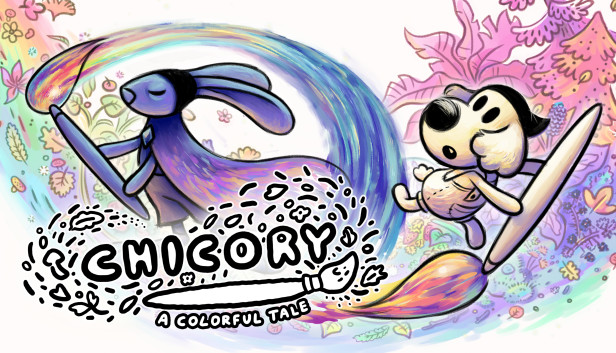
Chicory: A Colorful Tale ~ a meditation

slurpy artistry

Chicory: A Colorful Tale on Steam 

Color has been sapped from the world. As the wielder of a magical paintbrush, you are tasked with restoring vibrancy. Essentially every part of this game is an empty canvas. Map segments feature buildings, trees, and denizens, all of whom you can paint with the slurp of your brush. Backgrounds are rendered with thick outlines, as if they were sketched in Faber-Castell pen. The grass, the water, little flowers and ivy-- everything (and I mean basically everything) is waiting for a splash of color, but beware perfectionists: this game wants you to be sloppy.

I played on PS4 using the dual-shock touchpad. My finger guided the brush, and the controller emitted ooey gooey noises with each stroke. You can adjust the size and pattern of your brush; however, it is still finicky by design. Chicory: A Colorful Tale isn't about making virtuosic masterpieces. It is about learning to embrace and even cherish perceived imperfection.

Without spoiling anything, the game tackles questions of artistic identity. The protagonist and the titular Chicory act as foils for one another, each struggling with self-doubt, perfectionism, and convergent life trajectories. I'm charmed by how fully these two complement one another, being at once friends, teachers, and fleeting enemies.

Despite all of the positive, innovative qualities in this game, I am most smitten by boss fights. These sequences offer a refreshing change of scenery, with battles set against an entirely black backdrop. The combat system is a tad clunky -- yet I cannot overstate just how stylish it is. The pulsating music, the bright teal and red strokes splashing across a black expanse, it all comes together so exquisitely. Battles feature inverted colors and bullet-hell evasion, evocative of Undertale but not derivative. In battle, brushstrokes are not permanent. The paint does not stick but is quickly subsumed by darkness. In these moments, I reflect on how Chicory: A Colorful Tale subverts typical gaming tropes. It asks you to be creative far more often than it demands destruction. Battles contrast with other elements of gameplay, such as puzzles, platforms, and painting. Rather than being a regular mechanic, these moments are a thematic culmination, embodying the doubt and hopefulness inherent in art.

Chicory: A Colorful Tale is a heartening story. It offers a glimpse of what games can be rather than recycling old conventions. Ultimately, it asks players to participate in the making of world and a legacy.

Wednesday, June 23, 2021

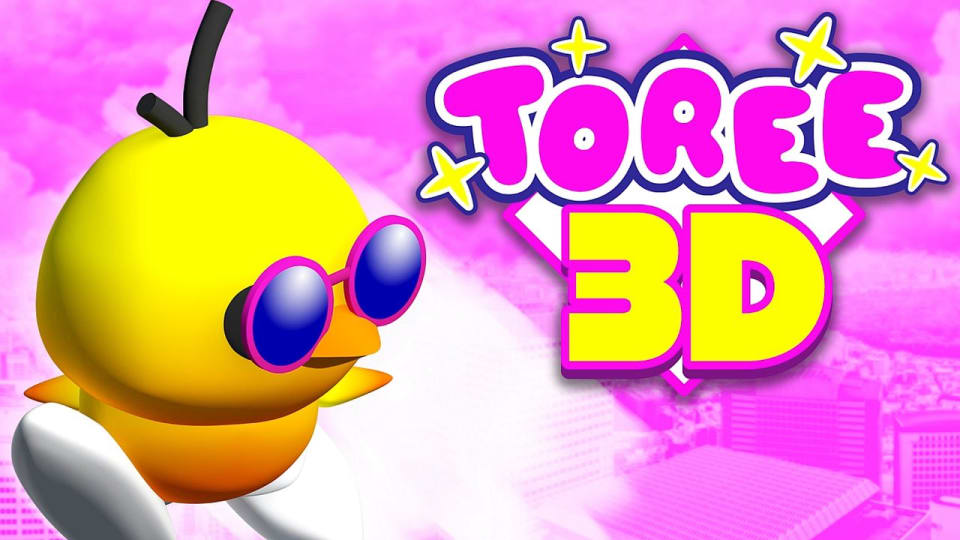
Toree 3D ~ Brief Thoughts

haunting vaporwave

Toree 3D for Nintendo Switch - Nintendo Game Details

Brief thoughts for a brief game. Toree 3d is a colorful romp. The controls are smooth, the platforming is snappy, and the world is unabashedly simple. Players hop, plop, and scamper through PS2 era graphics. There are sinister visual motifs scattered throughout this game, giving it a degree of mystery. It is becoming more common nowadays for games to experiment with tonally dissonant elements (e.g. cutesy + horror). Toree 3D accomplishes this experiment.

Moon: Remix RPG Adventure ~ a meditation

 I finished a very special game.

I am walking to the catchy beat of a stereo. Hip, experimental grooves accompany me across tracts of forest and desert. Eventually, I stumble upon a man perched on a cliff side. He is holding a guitar. I place a bet: 50 yenom for a bluebird. The man strums a sullen chord and I sit down beside him. We wordlessly monitor the sky, waiting for a single bird to pass by.

*

I am friends with a bird in town named Yoshida who invites me to a distant island. I am told that the journey will take roughly a day and a half. I clamber into a human-sized birdcage and am lifted upwards, charioted through the sky by a flock of birds tied to the cage by string. I anticipate a short cut-scene before arriving at my destination -- but no. I retain control of my character within the snug cage; I can barely move. The clock continues inching forward at regular speed. The wait is long, serene, pastoral even. Yoshida forecasts the weather and points out constellations as evening subsides into night.

*

There are few games that demand patience like Moon: Remix RPG Adventure. Moon often incentivizes waiting and marveling. It asks players to deny immediate gratification, instead opting for a more dutiful and attentive approach. To play Moon is to delight in a long, uneventful walk while listening to music. To play Moon is to amble through your own bewilderment.

Originally released for the Playstation in October 1997 (Japan only), Moon: Remix RPG Adventure has gone on to inspire games like Undertale. It has also implicitly shaped subversive game design (the "anti" RPG). Moon finally made its way to the west over 20 years after its original release, in September 2020, translated by the sesquipidallian Tim Rogers. While many of the game mechanics are outdated now, this is a perfect instance of "better late than never!"

What Moon lacks in action, it more than makes up for in absurdity. The setting is expansive, lush, and surprising. Ghostly animals occupy the landscape, separated from their bodies. You are tasked with bringing them back to life, undoing the death caused by a stereotypical RPG hero. This is where the "anti" RPG originates. You still gain levels, but these are earned through acts of kindness rather than violence.  

What's more, Moon's Playstation-era graphics complement thematic underpinnings. The quirky, putty-textured characters emphasize wonderment. Creature designs range from stylized humans to absurd monsters. Everything from the plodding day-night cycle to the lulling piano music in Granny's cottage fosters a sense of nostalgia, like being drawn into a warm embrace. 

These feelings persisted even as I watched a rocketship propel itself through the dark, slow pulse of nothingness. I finished Moon: Remix RPG Adventure in January, but I'm still thinking about it six months later -- just as I reflect on the long gone comforts of childhood.

Tuesday, June 22, 2021

Gris - Brief Thoughts

  GRIS for Nintendo Switch - Nintendo Game Details

Gris is a puzzle-platformer game, often lauded as a work of visual art. It features a wordless story, told largely through artistic flourishes and gesticulation. The inky watercolor backgrounds resemble a daydream.

Our protagonist gains abilities that facilitate her adventure through this dreamy world. Each stage contributes a new color until the world is brimming with yellows, reds, blues, and greens. The art direction is breathtaking with abstract sculptures, teetering buildings, and cliffs punctuating a vast psychological landscape.

While I floundered for the first few minutes, I quickly developed an intuition for Gris's puzzles, inferring what to do based on visual cues. Gris reminds me that video games are a language. Developers teach us this language through small scale design choices, such as a cracked boulder or a glowing light. In an age where games elaborate through excessive tutorials and dialogue, Gris embraces powerful silence.

While I found myself stirred by Gris, I will admit that it is esoteric. There are obvious undertones of loss, grief, and rejuvenation here, though they only ever manifest through metaphoric cutscenes. The gameplay sometimes prolongs segments past the point of novelty, stalling emotional revelations or (at worst) intruding on my ability to fully behold the art. For every moment like this, however, there are three others that ask the player to move through the game as if through a painting. 

While Gris is not the most enjoyable game I have played, it is the only painting I have ever played -- and that is a testament to its significance!

Bugsnax - Brief Thoughts

Bugsnax - Wikipedia

Bugsnax is a vibrant, poppy world, populated with delectable monsters. On a deeper level, this game offers a metacommentary on the monster catching genre, asking players to contemplate what monsters represent and the purpose of collect-a-thons more generally. Collecting fills an existential void, allowing characters to confront their insecurities. As characters gradually morph into an assemblage of foodstuff, it becomes clear that snacks are a diversion rather than a solution. 

While the interplay between its cutesy aesthetic and sinister plot could have resulted in tonal dissonance, the two halves of Bugsnax are surprisingly compatible. Video games do not have to be fully escapist, nor do they have to confront dark realities directly. Bugsnax has created a world that is both whimsical and tragic, allowing players to reckon with difficult truths while still deriving enjoyment.

Sunday, February 2, 2020

Monster Hunter Stories: a meditative review

I'm standing on the edge of a monster nest, a variety of speckled, striped, and star-patterned eggs sprawling in front of me. I rummage through the eggs, choosing a purple and green one. It's larger than my torso. I heft it and hobble away from the nest.

My monster, Kandy, follows at an eager trot. She's a Yian Kut-Ku, meaning she has a throaty orange beak, decorative head-flaps, and wings. She looks nervous. A cat called Navirou rides on her back, whispering warnings. Just then: a monster appears. A honey badger the size of a polar bear, with vibrant streaks of neon yellow and blue. It rears and flickers a huge tongue.

I run with my egg, desperately trying to escape the monster as it charges. Considerations flash through my head: am I ready for a battle? Is this egg even worth the fuss?

The monster misjudges, slams into a wall. I just barely squeak away.

When I return to the village, I hatch my pilfered egg. I take my 3DS stylus and gently tap the egg, causing cracks to fissure across its surface. It splits open, casting particles of light across my upper screen: Arzuros. My new monster.

what's so special about this installment?

I've tried Monster Hunter games in the past in search of a long-lasting gaming experience, but they all felt too lonesome and overwhelming. Monster Hunter Stories is different.

I was immediately drawn into its hyper-saturated world. Hakum Village, the beginning hub and home to Monster Riders, is arranged for utmost intimacy and familiarity. The protagonist's house is adorned with whimsical ornaments; a jack-o-lantern, a plush velocidrome; everything about the color palette evokes memories of childhood.

While equally colorful, the world outside Hakum Village feels more alien. The landscape is scenic but sparse. Almost primordial. Monsters amble through meadows, forests, and craggy mountains. Most will attack if you enter their sightlines, initiating a turn-based battle system.

Whereas the vastness in mainline Monster Hunter games feels isolating, the vastness in Stories makes me feel more attached to my monsters who act as companions, mounts, and battle-partners. Nothing is quite so thrilling as whistling for my monster and then hopping on her back. I adore watching her talons stir leaves or snow from the ground as we gallop spiritedly towards our next destination. You can even fly on monsters. I've flown my Rathalos over deserts, hills, and crags towards tantalizing blue mountains. While I love watching the scenery unfold, it's almost more rewarding just to study my monster's rippling, membranous wings. The whip of her tail. The tug of wind. In such an open world, I never thought I would focus so much on the little details, from the inquisitive tilt of a Yian Kut-Ku's head to the lumbering sway of an Aptonoth. Monster Hunter Stories is beautiful.

so let's talk about the monsters...
It's no surprise that Stories is often compared to Pokemon. After all, you're collecting and fighting with a variety of (not-so-pocket-sized) monsters. The designs are top-notch, spanning from majestic to downright whimsical. In my current party, I have fearsome cast of "monsties," including a shark-amphibian I've named Zippo and an eyeless wyvern named Radish. My favorite designs are those that resemble avian dinosaurs (think: bright colors, wings, claws, and feathered tails.) The monster designs often feel both playful and ingenious, like actual evolutionary possibilities.

With a cast of beasts so varied and ferocious, how does Monster Hunter Stories explain human-monster companionship? This alliance is made possible via "kinship stones." A kinship stone consists of a bracelet ornamented with a glowing blue gem. This stone allows Riders to activate powers during battle. Kinship powers function like Z-moves in Pokemon, except the animations are far more fluid, atmospheric, and diverse--not to mention: each monster has its own power! This adds oodles of personality to an already lovable roster of creatures.

let's talk about monster "domestication"
Like any spinoff game, Monster Hunter Stories approaches its mainline franchise from a new perspective. It does so by asking the following question: "what if monsters were beloved companions?"

This question puts MHST at odds with the main series, wherein hunters methodically attack, kill, and plunder their prey. While this cycle is also present in Stories, there's a greater need to justify why monsters should be killed. Stories justifies this with "the Blight," a mysterious illness that turns monsters savage. Monsters afflicted with the Blight lose all agency. A purplish-black mist seeps from their bodies.

There are a number of elegiac moments in Stories after defeating a blighted monster, when you (the protagonist) and Navirou mourn over its condition. Moments like these are offset by hundreds of other battles with non-blighted monsters to grind levels and gather materials. The contradictory "respect-and-neglect" for monster life comes from its main series roots. This is, after all, a Monster Hunter game.


concluding thoughts
Stories is more than happy to celebrate the bond between you and your monsties, but it shies away from a darker truth: you've raised your monsters from an egg to fight against their own kind.

I'm not as alarmed by this in other monster-taming franchises. Pokemon are integrated into human life, serving as assistants, pets, and companions. Battles are not life-threatening. Digimon can talk, so there's a certain degree of agency in their alliance with humanity. The more I think about it, the less Monster Hunter Stories feels like a a tale about "fantastical monsters," and the more it feels like a tale about wilderness and domestication.

Who raised the first wolf as a pet? When did someone first pilfer a bird's egg from the nest and call themselves a falconer? Is it "natural" to tame other species and are we bridging a divide in doing so, or stealing something precious from nature?

I consider these things as a sneak into a rare monster den with Kandy trotting doggedly behind me. After dodging velociprey and aptonoth, I stumble into a quiet chamber. On a high mound, surrounded by rocks and ivy, I find a clutch of monster eggs. They are purple and yellow. I must grab one quickly or else a monster will find me. I rustle through the eggs. I heft one to my chest. It's smelly and heavy. Life wriggles beneath its shell. Navirou voices a warning as I hobble away, carrying the next generation of monsters with me.
Sunday, October 13, 2019

Speed Running: a Meditation


Every movement counts. Every twitch of the finger. Every tilt or flick of the joystick. Glitches, hidden passageways, frame-perfect jumps and loading zones.This is about urgency, precision, near-inhuman perfection. This is the speedrun.

Ostensibly, speedruns began in the early to mid 90's. They've grown in popularity ever since, accumulating forums and devoted fan communities. Certain games lend themselves to speedrunning more than others, especially games that can be exploited for maximum efficiency or "optimization."

Speedruns teach us that coding is imperfect. What appears like a polished game on the outside is actually a patchwork of numbers, textures, and inputs. If you move at the right angle or perform the correct series of jumps, you can circumnavigate things like cut-scenes, further optimizing your playthrough.


In this post, I will explain and explore the phenomenon of speedrunning, not just as a hobby, but as a genuinely worthwhile endeavor.

at a glance...
Before launching into the deeper value of speedruns, I want to take a moment to discuss its scope.

speedrun.com has a list of runs, records, and categories. Upon visiting this site, you will see recently completed speedruns. Most games fall beneath the following three main categories:

  • Any % - players must complete the run in the fastest possible time. Period.
  • Low % - players must complete the run amassing only the collectibles and requirements that are absolutely necessary for completion.
  • 100 % - players must achieve all collectibles and requirements.
Depending on the game, there can be additional percentages or caveats. For example, Super Mario 64 is divided into 0, 1, 16, 70, and 120 star runs. Some games involve level-skips. Others must be played all the way through. The longer the run, the more stamina and consistency is needed for optimal completion. Speedruns are also divided into subcategories, such as glitchless, all/no bosses, and even blindfolded! There's no shortage of variety here.

is speedrunning reductive? 
At first, speedrunning appears to be about competitive efficiency. How fast can you get from point A to point B? What movements or glitches will save time? What is the cost or benefit of RNG?

I was initially skeptical, because I consider myself more of an atmospheric gamer. Games are experiences. They are an extension of reality. So what does it mean to breeze through that experience, sacrificing parts of it along the way?

Watching a speedrun, it's easy to forget how much practice goes into each movement. Speedrunners spend hours exploring and experimenting. During runs, they flex multiple skills, demonstrating coordination, "geographic knowledge," and an intimate understanding of the game as an instrument. The more you acquaint yourself with speedruns, the more you realize: these are not just robotic, ruthlessly efficient movements. These are movements that have the practice and grace of a virtuoso violinist. It's not just a skill, it's an art.


if not reductive, then productive?
Let's first take a moment to acknowledge the stigma surrounding gaming. I won't go too deep here, but I do want to mention how capitalism stresses the "work versus play" divide. In this false binary, everything categorized as "work" is productive, whereas "play" is unproductive or even counterproductive. The cultural sentiment I grew up with was: "video games will melt your brain." The older I get, however, the more absurd this sentiment becomes. Video games are just another layer of experience, adding complexity and intrigue to our daily reality.

This brings me back to speedruns. While playing a game as fast as possible might appear "unproductive," speedrunning actually involves both work and play. Any % speedrunners must familiarize themselves with the quirks and constraints of their game. How can the game's perceived "reality" be shattered? Where is the game's illusion (programming) weakest? In glitch runs, players jump backwards, judder, and clip through walls. Rules were made to be broken. Nothing is quite as it seems.

Perhaps this is a stretch, but speedrunners are like digital philosophers. They question, deconstruct, and rearrange the world that they have been given. This is what makes speedruns so exhilarating. Watching them feels law-defying.

Speedrunners are doing good things, too! At the semiannual event Games Done Quick (GDQ) the most skilled runners gather together to stream games and raise money for charities like the Prevent Cancer Foundation and Doctors Without Borders. GDQ turns gamers into donors. Our excitement about digital realities can yield real-world benefits! If that isn't productive, then I don't know what is.

so what?
Throughout the last century, humans have approached new technologies with skepticism. Won't digital realities make us lazier, duller, and somehow less human? While these fears are not wholly unfounded, technology can also make us more human. After all, what is more human than forming competitive communities and sharing knowledge?

Video games are still a recent development, but already, they have attained enormous cultural weight. How we interact with games says a lot about us as a species. "The speedrun" is no exception. Let's all take a moment to appreciate speedrunning as something more than just a hobby, but as an art, a philosophy, and a potential source of good in the world.